Laura Ricketts Designs

"She seeks wool and flax, and works with willing hands..."

Laura Ricketts Designs is a personal and business website for Laura Ricketts, hand-knitwear designer, author, teacher, crafter, mother and wife.

Neiden, Norway

*This blog is about a trip I took last month.* 

Eeva and I boogied on out of Finland, experiencing more lakes, birch, and lonely roads. Toward dinner, we saw it: the Norwegian border. 

Finnish-Norwegian border

Finnish-Norwegian border

At each border crossing, there were signs to go very slow, about 15 mph, and there was a office building, but one doesn't have to stop the car unless someone comes out and waves. As a result, the only crossing I had to show my passport was on a layover in Germany on the flight home.  

The wooden "bridge" in this picture was for snowmobiles and reindeer. Eeva drove the border again, and I walked the bridge.  Again.  All the way to Norway. 


IMG_6530.jpg
Welcome to Norway, Sør-Varanger county

Welcome to Norway, Sør-Varanger county

Before long, we were driving along the Neiden river.  Friday and Saturday night we stayed in a Neiden camp grounds, or stua. 

IMG_6556.jpg

Because it was the weekend, and summer hours were over, there wasn't as much to do.  Saturday, we drove to Kirkenes. We stopped at the museum there, but my contact wasn't in that day.  So, we looked at the mittens, and then went on to downtown.  We stopped at a tourist center, that was closed, the library, that was closed, and a Salvation Army, to buy a fleece after I left mine in Finland.

Neiden river

Neiden river

IMG_6565.jpg
IMG_6566.jpg

Kirkenes is the easternmost town in Norway.  Russia is not far away at all.  Before the trip, Eeva and I had talked of trying to do the border crossing during this visit.  It turns out, Russia requires a $50 visa, obtainable only in Washington DC.  We didn't want it that badly.  Whenever we mentioned a border crossing to people in this town, they got noticeably tense.  Not the nicest border crossing ever, I guess.  Everywhere in this area were posted signs warning of Russian border control patroling within 100km, I believe.  It felt very alien. 

Instead of running the border, we ran to the NE corner of Norway, to put our toes in the Berings Sea. I'll try to link a map here.  Click the "here" to connect.  We drove the dirt road up to the Berings Sea and SOMEONE refused to take her socks and shoes off.  Yes, it was windy and cold, but it was the Berings Sea, people.  Here is a picture of the brave little foot that could.

And, yes, that's long underwear under my jeans. 

And, yes, that's long underwear under my jeans. 

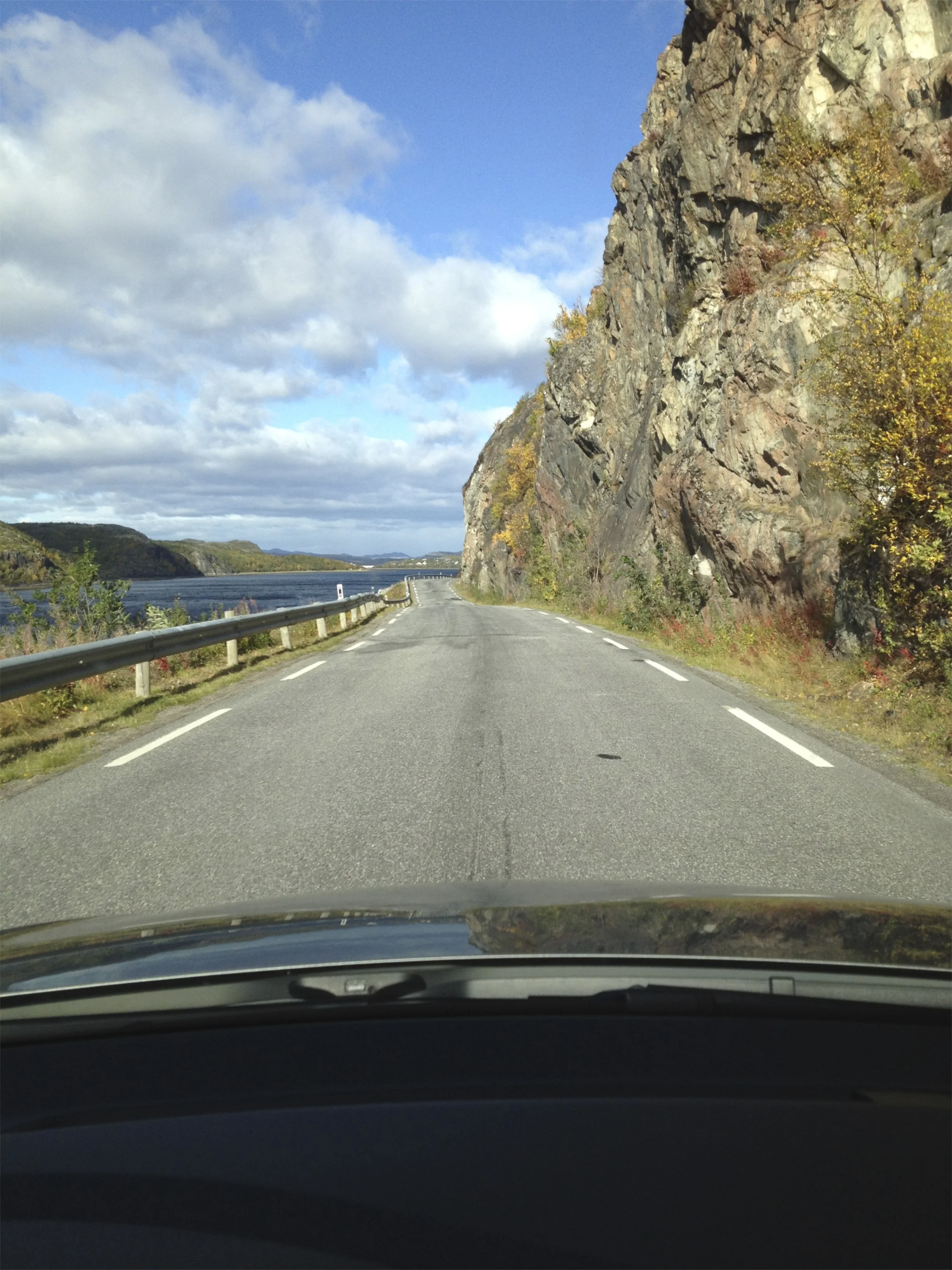
The drive out was beautiful. 
IMG_6580.jpg
the base of the fjord

the base of the fjord

IMG_6596.jpg
IMG_6598.jpg
IMG_6599.jpg

The Samisiida, the Finnish Sámi Museum, and Sajos, the Sámi Parliament

Friday morning dawned bright and early. Eeva went for a swim in the lake (brrr!). I opted for a more comfortable warm shower.  

We're here! 

We're here!


The view at the hostel

The view at the hostel

At 8am I was at the Samisiida museum with curator Aile Aikio. What a wonderful time! She and I had emailed quite a bit over a year ago, and I was quite looking forward to meeting her. Every once in awhile you meet someone who has the right job, enjoys it and excels at it. Aile is such a person. She has a finger on the pulse of the Inari community.  She interviews elderly in senior centers; she collects stories; she collects materials.  As a result, she has so much information about so many aspects of the Sámi life. One undesirable effect of this knowledge is "ethno-stress" -- the stress of knowing all the history and "right" ways to do things. Does the life of Sámi culture depend on them? Sometimes it feels so.  It can be a heavy weight to bear.

Happily, one area she knows much about are Sámi mittens from her area. Before I talk mittens, however, let me educate you about the Sámi in Finland. The museum had exhibits on both of the following sub-groups and had mittens from both as well.

The Sámi peoples have about 9 subgroups. Most of these subgroups have a wide land area. Only one of these sub-groups is within one country only, and that is the Inari Sámi.  They are found within Finland, around Lake Inari. They herd reindeer near the lake and enjoy other lake activities. Their national costume has green in it, not common with most other sub-groups.  Likewise, their mittens often have green.

The other Sámi sub-group mostly found within Finland, the Skolt Sámi, have their original homeland divided between Norway, Finland and Russia.  Approximately half of it is in Russia. Around 1935, they were instructed by the Russian government that the borders were closing: get out or stay. Most left, but were allowed back in a year later. 

In 1947, they were told again: get out or stay. Most left to Finland.  They have never been allowed back in. The majority of those who remained in Russia were collectivized and moved to the town of Lovozero.  Their reindeer were seized and collectivized as well. Much of their culture was destroyed. Less than 2,000 Skolt Sámi remain in Russia.

Of those that remained in Finland, many settled in Sevettijarvi, north of Lake Inari. You must understand, that the Skolt Sámi living in Russia for 100s of years were influenced by the Russian majority.  Many have Russian last names, wear Russian influenced outfits, and are Russian orthodox by faith. They, however, are not Russian. 

As a generality, Finns hate Russians.  The Finns have had bitter conflicts and many wars with their giant, overbearing neighbor to the East. Russia has so many people and so many resources compared to this small neighbor, so naturally, they almost always won. So, when Russian speaking Skolt Sámi fled to Finland, the Finns didn't exactly greet them with open arms. When Skolt Sámi moved near lake Inari, the Inari Sámi weren't exactly thrilled either. The Sámi peoples have been discriminated against by their majority cultures for over 100 years. Now the discrimination was within their community. As a result, the Skolt Sámi were treated as the lowest of the low.

Their culture is fascinating, though. Sevettijarvi has a beautiful small orthodox church, reindeer, lakes and birch trees.  The traditional women's costume includes the old horn hat, long skirts and shawls. The men wear Western dress and were the first of the Sámi peoples to drop traditional clothing. The women stopped wearing the reindeer skin leggings, and so became the only Sámi people to wear knit socks in the traditional costume. 

The Skolt Sámi have distinctive mittens.  Most of them are plain on the hand and patterned only on the cuff.  The patterning is every other stitch, with the stitch inbetween in the base color. Many of the patterns have names, as well: ptarmigan's foot, boat's bow, and netting. As you may guess, fishing and bird trapping are a part of everyday life.

Unfortunately, I don't have a picture of the museum.  Here are some pictures of the parliament building just around the corner.  I've read somewhere that it is shaped like a reindeer bone.

The Finnish Sami Parliament in Inari, Finland

The Finnish Sami Parliament in Inari, Finland

IMG_6373.jpg

Inside is a rather nice handcrafts shop with books, shawls, jewelry, CDs and knitting. 

Skolt socks

Skolt socks

Finnish mittens, River Sámi mittens, Inari mittens, and Swedish Lovikka mittens

Finnish mittens, River Sámi mittens, Inari mittens, and Swedish Lovikka mittens

We filled up on diesel, visited a small grocery and bought some food for the following days in Norway. I bought an "Angry Birds" candy for my eldest (Angry birds is one of Finland's biggest exports these days!).  Then, we loaded up and headed for the border. 

Tomorrow: Norway! 

Inari, Finland

The road from Jokkmokk, Sweden to Inari, Finland was long, beautiful, and partly gravel. We started off driving over the Lule river and past a dam, heading up to Gallïvare and then East to the Muonio river. The vast part of the border between Sweden and Finland is the river Tornio, but we were north of that, I guess. On the way to the border we encountered our first construction which slowed us down quite a bit.  When we got through it, we made a wrong turn which detoured us for about 2 hours/200km. Well, we got to see more of Sweden!

We also got to see more reindeer up close and personal.  Aunt Cari (and everyone else) had warned of reindeer -- LOTS of reindeer on the road.  They weren't joking. 

IMG_6291.jpg
a little reindeer calf

a little reindeer calf

mama 

mama 

mama and a one year old

mama and a one year old

I learned a lot about reindeer, too, from my three weeks, besides they are delicious.  All reindeer get fuzz on their horns, but the female keeps it on far longer, while the male rubs his off.  In the summer reindeer herders take the reindeer to summer grazing pastures, usually by the coast, and in the winter they come back inland.  Reindeer eat lichen in the winter and paw through the snow to get to it.  Having seen this land, it is such a marvelous providential match, as the land is very sandy or rocky, there is lichen everywhere, and the land is not well suited to cultivation, especially with the short growing season.

These reindeer are in their summer grazing area.  I did not see many reindeer in Norway, as their summer grazing area was not near where I was. 

When we approached the border, Eeva took my picture and drove across the bridge.  I chose to walk. All the way. To Finland.

Still on Swedish soil

Still on Swedish soil

mid-way on the bridge

mid-way on the bridge

may have been a little windy...

may have been a little windy...

Made it!

Made it!

We had coffee in Kolari and filled up with diesel in cheaper Finnish fuel, and headed out toward Inari again.  Before long, the road, the only road, became dirt.  Reindeers abounded. 

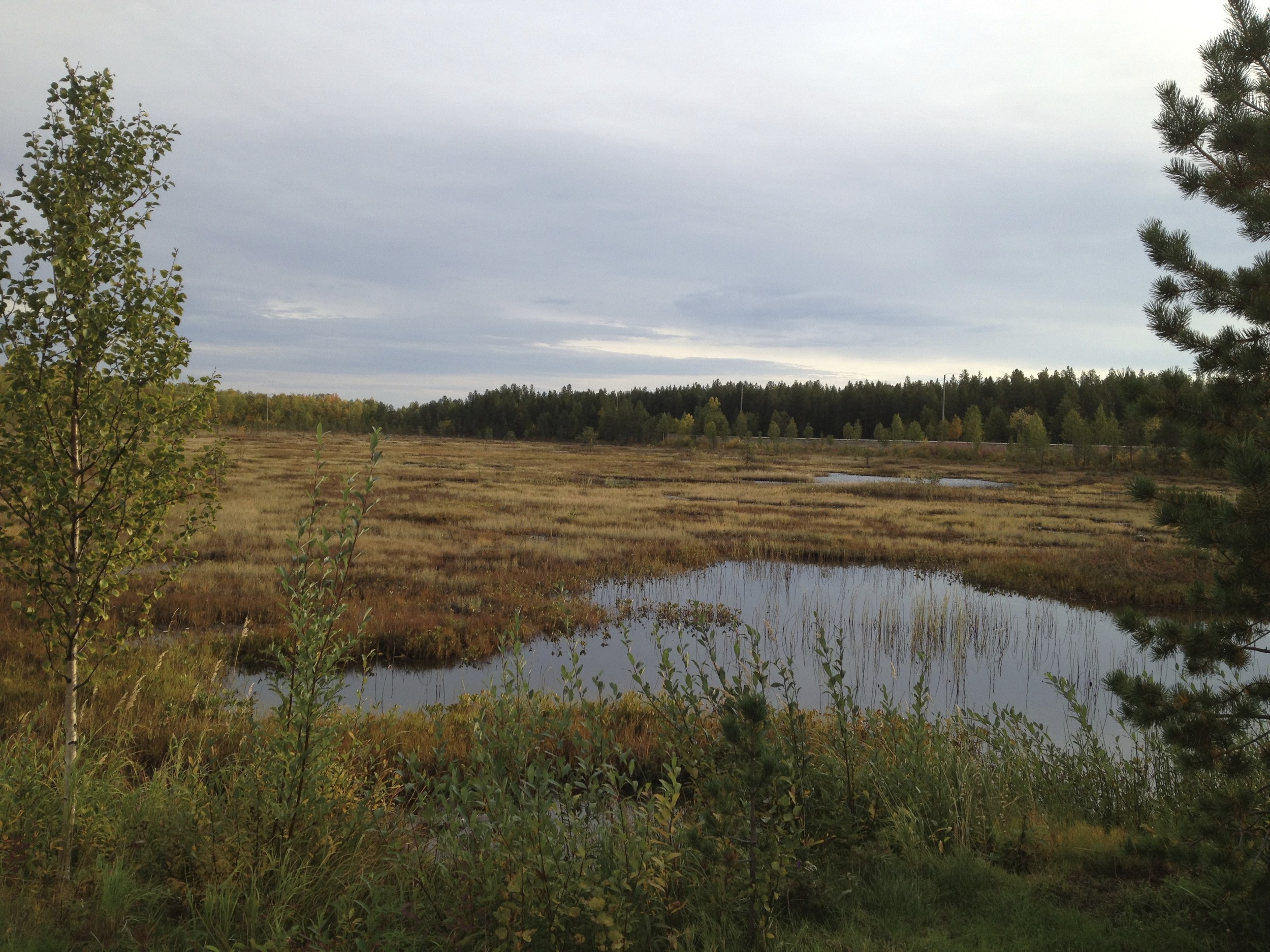
It turns out, Finland is named for its fens.  Fens are marshes or bogs.  Northern Finland is full of lakes, bogs, marshes, fir trees, and birches.  It's beautiful.  Not the high mountains or fjords of Norway, but beautiful nonetheless.

Once we got to Inari, we headed north to the hostel and settled in for the night. Another full day was ahead of us.

Jokkmokk and away!

*this blog post is about a trip I did last month.* 

On Wednesday morning, Eeva and I got up early, took the train to Arlanda, and flew to Luleå, Sweden in the northmost county of Norrbotten.   

catching the train to Arlanda

catching the train to Arlanda

Luleå is a beautiful city.  The main part of the city is on an island situated in the mouth of the Lule river on the topmost corner of the Bay of Bothnia. It was the traditional home of the Lule Sámi. This visit, I got a rental car and quickly drove up to Jokkmokk, but, I will write more about Luleå upon my return. 

Rural Sweden is beautiful with rolling hills, red houses and many rivers and lakes. 

About halfway to Jokkmokk, we passed the Arctic Circle. 

As you can see, my feet are just beyond the signpost, so I am in the Arctic circle!

As you can see, my feet are just beyond the signpost, so I am in the Arctic circle!

On the sign, the blue map is Norrbotten County, and the yellow dash line indicates the Arctic Circle.  The Arctic circle is imaginary line of latitude above which the midnight sun can be seen during summer solstice.  Alternatively, above this line the sun never rises in mid-winter, but one could see the Northern Lights. 

Before too long we were in Jokkmokk and at the Ajtte Sami museum. 

a bad picture of a good museum

a bad picture of a good museum

Jokkmokk is well known for its (outdoor) Winter Market, the second weekend of February.  It has been an institution for 400 years.  Seriously.  Many people come from all around to sell handcrafts.

As for the museum, I highly recommend it.  Very well laid out.  Wonderful information.  Beautiful, huge pictures by Laila Duran in the lobby...  There is a lovely area displaying all the regional Sámi costumes, including reconstructed mittens.

I quickly hustled to a conference room, where I met with the curator Sunna Kuoljok and an expert mitten knitter, teacher and collector, Erika Nordvall Falck. We looked and looked at mittens, talked a mile a minute and, of course, I took many photos. 

Erika is teaching this week about Swedish Sámi mittens at a mitten symposium in Tromsø, Norway. Go if you can! 

the walkway on the mainstreet of Jokkmokk

the walkway on the mainstreet of Jokkmokk

After my meeting at the museum, Eeva and I walked up and down the main street, visiting the hemslöjd, stopping to buy walking shoes, since my checked bag never arrived, eating reindeer pizza with lingonberry sauce, and trying to find a legendary mitten display.  Never found that one.  Sigh. 

We slept that night in my first of many hostels/stues.  The next morning we went for a long walk around a beautiful lake just to the Northwest.  Then, it was off for a day's drive to Inari, Finland.

me and my reindeer pizza leftovers, and its cousin, Blitzen

me and my reindeer pizza leftovers, and its cousin, Blitzen